
Florissant Divorce Decree Records
Florissant divorce decree records are filed and stored at the St. Louis County Circuit Court in Clayton. As a city within St. Louis County, all Florissant divorce cases go through the 21st Judicial Circuit. The Circuit Clerk's office at 105 South Central Avenue keeps the official files. You can search for basic case data online through Missouri's Case.net system or request copies directly from the clerk. This page walks through the steps for finding, requesting, and understanding Florissant divorce decree records in the St. Louis County court system.
Quick Facts
Florissant Divorce Decree at the 21st Circuit
The St. Louis County Circuit Court handles all divorce cases for Florissant residents. The court sits in Clayton, about 15 miles south of Florissant. It is part of the 21st Judicial Circuit and has jurisdiction over civil, criminal, family, and probate matters across St. Louis County. The Family Court division is the section that processes divorce filings and issues final decrees. The court has full authority over dissolution of marriage cases under Missouri law.
Florissant does not have its own circuit court. The city falls under St. Louis County for all divorce matters. When a Florissant resident files for divorce, the case goes to the St. Louis County courthouse in Clayton. The St. Louis County records guide confirms that divorce records in St. Louis County are official legal documents that provide evidence of the dissolution of a marriage within the county's jurisdiction. The Circuit Clerk maintains these records and makes them available to the public upon request, subject to certain restrictions on sensitive information.
Court hours run Monday through Friday, 8:00 AM to 5:00 PM. Walk-ins are accepted during those times. Call (314) 615-8029 if you have questions before visiting.
How to Search Florissant Divorce Records
The quickest way to look up a Florissant divorce case is through Missouri Case.net. This free tool covers all Missouri circuit courts. You can search by party name, case number, or filing date. Case.net shows docket entries, hearing dates, judges assigned, and case status. It will not display the full text of the divorce decree, but it tells you whether the case exists and if it has been resolved. The system is available around the clock from any computer or phone.
For a physical copy of a Florissant divorce decree, you need to contact the St. Louis County Circuit Clerk. You can visit the office at 105 South Central Avenue in Clayton. Bring the full names of both spouses and a rough date range. The clerk can pull the file and produce copies. Certified copies carry the official court seal and work for legal purposes like name changes, property transfers, and benefits claims. Plain copies cost less and serve well for personal reference.
You can also submit a written request by mail. Include all relevant case details, your return address, and a check or money order for the applicable fee. Processing times vary depending on how old the case is and how busy the office is at the time.
Note: Always confirm the case was filed in St. Louis County and not in the City of St. Louis, which operates a separate court system.
The screenshot below shows the Missouri Case.net portal, which Florissant residents can use to search for divorce decree case records filed in St. Louis County.
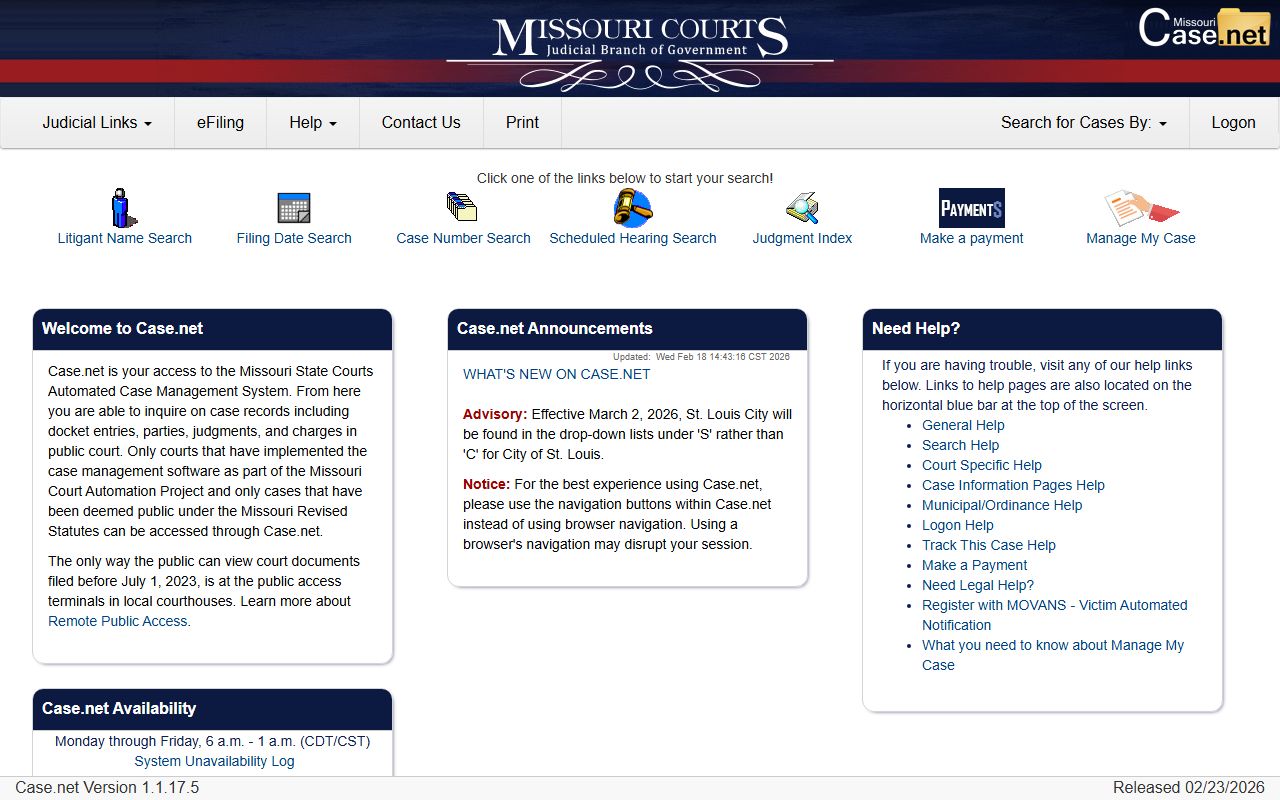
Case.net is maintained by the Missouri Office of State Courts Administrator and provides free access to case information across all circuits.
Florissant Divorce Decree Filing Steps
Filing for divorce in Florissant follows the same process as anywhere else in St. Louis County. Under RSMo Chapter 452, at least one spouse must have lived in Missouri for 90 days before filing. The petition is filed with the St. Louis County Circuit Clerk. Missouri is a no-fault state, so neither party needs to prove wrongdoing. The petitioner simply states that the marriage is irretrievably broken. After the petition is filed, there is a mandatory 30-day waiting period before the court can grant the decree.
The filing process involves several key documents. The petitioner must file a Petition for Dissolution of Marriage, a Statement of Income and Expenses, and a Parenting Plan if children are involved. Missouri courts offer approved divorce forms for people who cannot afford an attorney. These forms are available on the Missouri Courts website. They cover both contested and uncontested cases.
Property gets divided according to RSMo 452.330, which calls for equitable distribution. Child custody decisions follow RSMo 452.375 and focus on the best interests of the child. Spousal maintenance is governed by RSMo 452.335. The final decree, once signed by a judge, becomes a permanent record of the 21st Judicial Circuit Court.
Restricted Records and Privacy Rules
Most Florissant divorce decree records are public. Case numbers, party names, filing dates, and the final judgment are all accessible. But certain parts of the file may be restricted or sealed. Financial affidavits, Social Security numbers, and child custody evaluations are typically kept from public view. If a judge issues a sealing order on the entire case, the file becomes off-limits to the general public. You would need a separate court order to gain access.
The Missouri state portal draws a clear line between divorce decrees and divorce statements. A decree is the full court order that ends the marriage. It includes property division terms, custody arrangements, and any other conditions the judge set. A certified statement, on the other hand, is a much shorter document issued by the state. It only lists the names of both spouses, the date of the divorce, and the county where it was recorded. The two are not the same, and they come from different offices.
Under the Missouri Sunshine Law (RSMo 610.011), most court records are open. But family law cases have extra protections for sensitive personal and financial data. The clerk's office can tell you what is available in a specific case file before you pay for copies.
State Divorce Decree Statements
The Missouri Bureau of Vital Records in Jefferson City issues certified statements for divorces that occurred in the state from 1948 to the present. Each copy costs $15.00. These statements are not the same as a full divorce decree. They confirm only that a divorce took place. The statement lists both names, the date, and the county. It does not include the terms of the decree, the property split, or custody details.
For Florissant divorce cases, the full decree must come from the St. Louis County Circuit Clerk. The state vital records office can not provide that document. If you need proof of divorce for a quick purpose like updating a driver's license or filing taxes, the certified statement from the state may work. For anything involving legal proceedings, property, or custody disputes, you will need the actual decree from the court.
The Library of Congress Missouri vital records guide notes that county-level divorce records in Missouri date back much further than the state database. The St. Louis County Circuit Clerk holds records from long before 1948. If you are researching an older Florissant divorce, the clerk's office is the only source.
Note: The Missouri vital records FAQ page has answers to common questions about ordering certified statements and who can request them.
Nearby Cities
If your divorce decree search involves other parts of the greater St. Louis metro area, these nearby cities may also be relevant to your records request.
St. Louis City operates its own court system separate from St. Louis County. St. Charles and O'Fallon fall under different judicial circuits as well. Make sure you know which county handled the original divorce filing before you request records from any of these locations. You can also browse all available locations on the St. Louis County divorce decree page for more details about the 21st Judicial Circuit Court and its services.