
St. Louis Divorce Decree Records
St. Louis divorce decree records are managed by the 22nd Judicial Circuit Court. Unlike most Missouri cities, St. Louis is an independent city and does not belong to any county. The Circuit Clerk's office at 10 North Tucker Boulevard holds more than five million court files dating back to 1804. If you need to search for a divorce decree or get a certified copy, the clerk's office is the place to start. You can also look up basic case data on the state's Case.net portal. This page explains the steps for finding and requesting St. Louis divorce records.
Quick Facts
St. Louis Divorce Decree at the 22nd Circuit
The 22nd Judicial Circuit Court is the sole court that handles divorce cases filed in the City of St. Louis. It operates from two landmark buildings in downtown St. Louis: the Clyde S. Cahill Courts Building and the Mel Carnahan Courthouse, both at the corner of Market Street and Tucker Boulevard. The court is a state court of general jurisdiction and hears a wide range of civil and criminal cases, including all family law matters. Courtrooms are open to the public during business hours.
The Circuit Clerk's Office handles the organization and storage of all court files. The office processes around 40,000 new civil and criminal cases each year. For divorce records, you contact this office directly. Hours are 8:30 AM to 5:00 PM, Monday through Friday. If your divorce took place in St. Louis County rather than the city, you need to contact the St. Louis County Circuit Clerk instead. The city and the county are separate jurisdictions.
This is an important distinction. Many people confuse the two. St. Louis City and St. Louis County have different courts, different clerks, and different filing systems. Make sure you know which jurisdiction handled your case before you request records.
How to Search St. Louis Divorce Decree Cases
The fastest way to check if a divorce case exists is Missouri Case.net. This free state tool lets you search by litigant name, case number, or filing date. It covers all Missouri circuit courts, including the 22nd Circuit. You can see docket entries, hearing dates, and whether the case is still open or has been resolved. It will not show you the full text of the decree, but it confirms the basics.
For a copy of the actual decree, you need to visit or contact the Circuit Clerk's office at 10 North Tucker Boulevard. Bring the names of both parties and an approximate date. Staff can pull the file and make copies. Certified copies carry the clerk's seal and are accepted for legal purposes. Non-certified copies work for personal reference. Fees vary based on the number of pages and whether you want certification.
According to the St. Louis Records guide, divorce records in St. Louis are maintained under Missouri Revised Statutes RSMo 452.310, which governs dissolution of marriage proceedings. Court divorce case files are generally available for public inspection under the Missouri Sunshine Law RSMo 610.011. That means case numbers, names of parties, filing dates, and the final judgment of dissolution are accessible to anyone who asks.
Below is a screenshot of the 22nd Judicial Circuit Court website, which handles all St. Louis divorce decree filings.
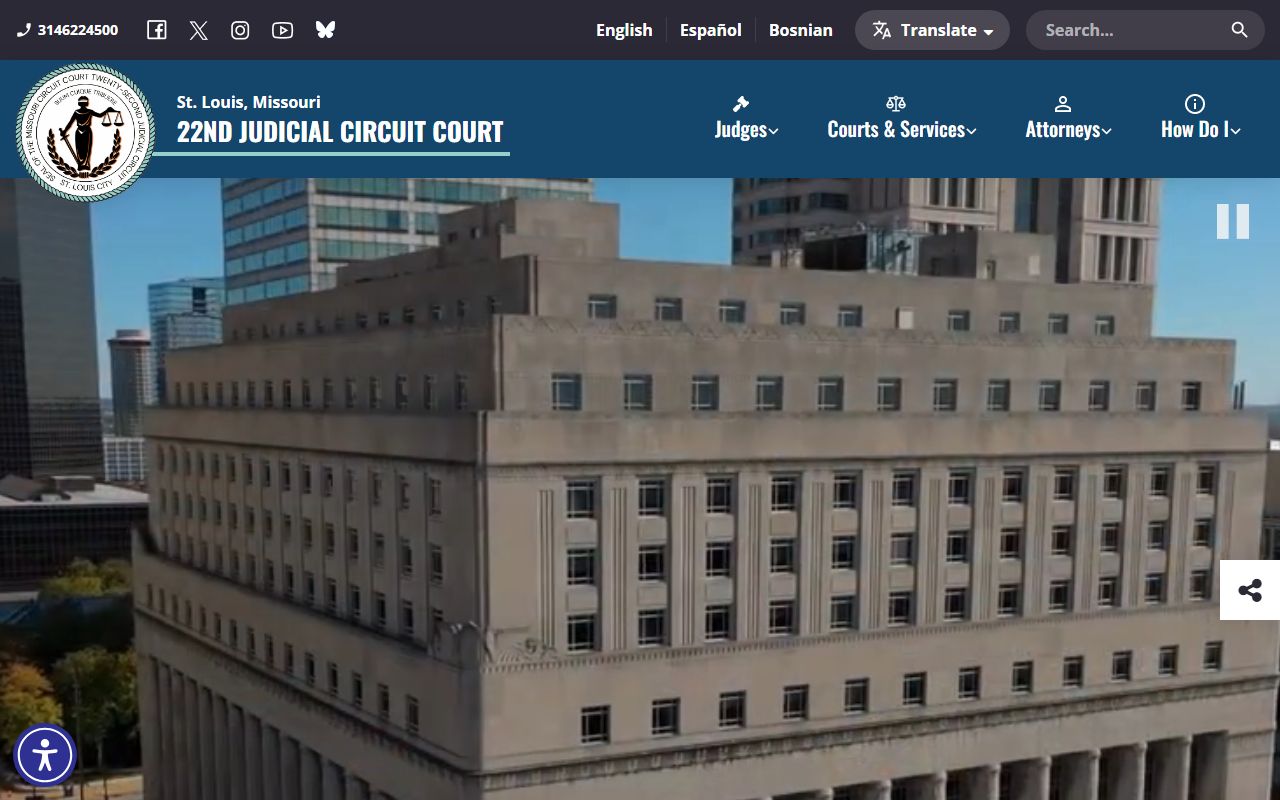
The court's website provides general information about services and how to access records for St. Louis divorce cases.
Restricted Divorce Records in St. Louis
Not everything in a St. Louis divorce file is public. Certain parts may be sealed or restricted. Financial affidavits and statements are often kept from public view. Child custody evaluations are also restricted. Any documents that contain Social Security numbers are redacted or withheld. And if a judge has issued a sealing order on the case, the entire file may be off-limits. You would need a court order to access sealed records.
Certified divorce certificates have more restricted access as well. Under RSMo 193.245, these certificates are available only to the former spouses named in the record, legal representatives with proper authorization, and people with a direct and tangible interest. The Library of Congress Missouri guide confirms that city-level divorce records for St. Louis are maintained by the Clerk of the City Circuit Court, while state-level records from 1948 to the present are held by the Missouri Department of Health, Bureau of Vital Records.
State Divorce Decree Statements
The Missouri Bureau of Vital Records issues certified statements for divorces. Each copy costs $15.00. These statements only include the names of both spouses, the date of the divorce, and the county where it was recorded. They do not contain the full terms of the decree. The Missouri state portal makes clear that divorce decrees can only be obtained from the Circuit Clerk in the county or city where the divorce was granted.
For St. Louis divorce cases, that means the 22nd Circuit Clerk is your source. Do not expect the state vital records office to have the full decree. They only have the summary statement.
St. Louis Divorce Filing Process
To file for divorce in St. Louis, one spouse must have been a Missouri resident for at least 90 days. The petition goes to the 22nd Circuit Court. Missouri law under RSMo 452.305 allows no-fault dissolution. Either party can state the marriage is irretrievably broken. After filing, there is a 30-day waiting period before the court can grant the decree. Property division follows RSMo 452.330, and custody matters fall under RSMo 452.375. The final decree becomes a permanent record of the court once the judge signs it.
Note: St. Louis City divorce records are separate from St. Louis County records, so confirm which jurisdiction handled your case before making a request.
Nearby Cities
If you are searching for divorce decree records in the broader St. Louis area, these nearby cities may also be relevant.